Can you install a sauna in a Jakarta apartment? Yes — and the route that almost always works is a free-standing infrared cabin: a 1.7–2.4 kW draw that demands no increase in the unit's power, no steam, no structural changes, installed in 1–2 days, priced IDR 30–70 million. A conventional dry sauna is harder but not impossible — especially in a penthouse. This article maps the whole route: why buildings refuse, what gets approved surprisingly easily, the documents that calm management down, and the maths on your unit's electricity.
Why the word "sauna" puts building management on alert
The picture that forms in a building manager's head on reading a "sauna" application: a 9 kW heater straining the electrical riser, steam seeping into the next unit, hot timber in a sprinkler-filled building. For a traditional dry sauna, some of that worry is legitimate — a big heater really does demand power above a standard unit's, and löyly sessions really do release moisture that needs planned ventilation.
The trouble is that refusals often land on everything named "sauna" — when technically an infrared cabin is an entirely different device. The job of a good application is to put that difference down in black and white.
Infrared: the route that's almost always open
A free-standing infrared cabin wins approval because every classic worry collapses against its spec sheet. Power: 1.7–2.4 kW — water heater class, not special-installation class; a 3,500–5,500 VA unit usually carries it with no upgrade. Steam: none — the panels heat the body dry, and the room's humidity doesn't change. Structure: the cabin arrives as flat panels via the service lift, assembles inside the unit like a large wardrobe, and can be dismantled and moved when you sell or relocate. Fire and surface temperature: certified panels with automatic thermal cut-offs; no glowing stones, no exposed elements.
In our practice along the Sudirman–Thamrin corridor and the Kelapa Gadingtowers, infrared applications with complete technical documents get approved far more often than refused. What decides it is usually not "allowed or not" — but how clear the file is.
The file that calms management down
We prepare a standard document pack for apartment clients, and its contents are simple: unit specifications (dimensions, weight, power, panel certification), an electrical load diagram showing peak draw against your unit's supply, an installation method statement (dry assembly, no structural drilling, no water lines), and a work schedule that follows the building's renovation hours. For buildings that ask, we add the team's work insurance.
The order of the application matters too: asking with a complete file before buying — rather than apologising after the cabin is stuck in the lobby — completely changes the dynamic with management. Our smoothest clients are the ones who sent our file to building management a week before the unit was ordered.
Unit electrics: the five-minute calculation that saves you
Before falling for a particular cabin, check three numbers in your unit. Installed capacity — in the PLN app or on the main MCB: 2,200, 3,500 or 5,500 VA. The biggest simultaneous load — how many AC units, the water heater, the washer-dryer; add up what realistically runs at once in the evening. The headroom — a 2 kW cabin needs that headroom free while in use. A 3,500 VA unit with two ACs and a water heater sometimes needs simple discipline: sauna sessions not while everything is on. A 5,500 VA unit has practically no issue.
Cables and protection stay at our standard despite the small draw: a dedicated run from the MCB, not a piggybacked T-plug, plus an ELCB. In a building, tidy electrics aren't just safety — they're proof to management that this work is professional.
Penthouses and big units: when a dry sauna becomes possible
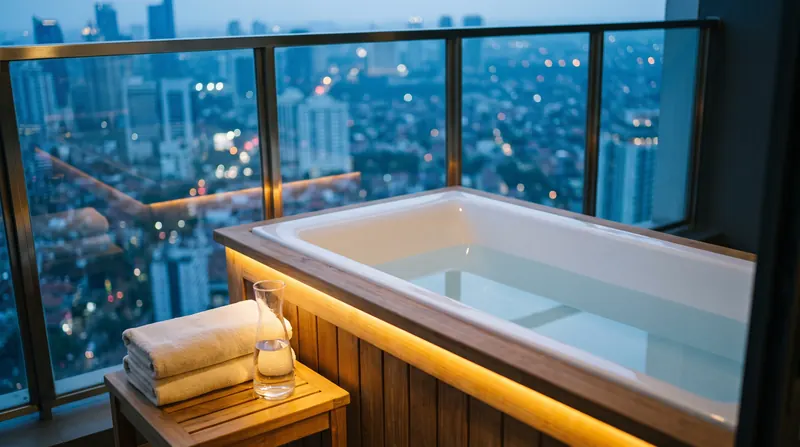
The top floor changes the rules. A penthouse with 11,000 VA or more, a private terrace and direct roof access opens options standard units don't have: a compact 2-person dry sauna inside, or even a cabin plus a cold plunge on the terrace — a contrast room with a city view. The approval runs deeper (terrace structure, water routes, sometimes P3SRS consent), but our precedents exist: the process is roughly a month of documents and a month of work.
For the majority of non-penthouse units, the realistic combination is still appealing: an infrared cabin inside + a compact cold tub in the bathroom with the chiller in the service area — a contrast therapy vertical version already running in several of our clients' units.
The checklist before you decide
Seven minutes that save months: (1) photograph the house rules' renovation/appliance section; (2) check the unit's installed capacity; (3) measure the cabin's candidate spot — a spare bedroom corner and the family room are favourites — plus the door and service lift widths; (4) ask management informally whether a similar application has come through before; (5) send it all to us on WhatsApp. From there the custom sauna construction team prepares a unit recommendation, the application file and the quote — the visit to your unit is free across DKI. So the quote holds no surprises, spend five minutes with our sauna cost guide — from cabin prices per type to the installation costs.
The full sauna type comparison — including why infrared wins in high-rises and when steam or dry is worth fighting for — is in our guide to choosing a sauna type.
Read next: A smart-home-connected sauna in Jakarta: phone preheat, schedules and sensors.
Read next: A quiet ice bath chiller: taming the noise for Jakarta apartments and townhouses.
The product that clears all the conditions above most often is the infrared sauna for apartments. We log building patterns per district on the Sudirman and Menteng apartment saunaspage, and for ice baths in high-rise units — in our article on quiet chillers for apartments.