Installing saunas in Central Jakarta means mastering two trades at once. For Sudirman, Thamrin and Tanah Abang apartments: a 1.7–2.4 kW infrared cabin that passes building rules and installs in 1–2 days, IDR 30–70 million. For the heritage houses of Menteng, Cikini and Gondangdia: a custom dry sauna fitted with respect for an old building — a new electrical run, a tight vapour barrier, no wounds to the original structure. Free surveys across Central Jakarta, and the 2-year construction warranty in both worlds.
World one: the vertical Sudirman–Thamrin corridor
Central Jakarta apartment dwellers are the people who need a sauna most in the whole city — packed schedules, high stress, premium gym access — and the ones most often told it's impossible. The truth is more nuanced. What's genuinely hard in a high-rise unit is a big dry sauna: a 6–9 kW heater strains the unit's supply, and hot vapour demands ventilation the building may not give.
What's almost always possible: a free-standing infrared cabin. It draws like a water heater, makes no steam, changes no structure, and can be dismantled when you move. To most building managers it counts as electronic furniture — not a renovation. We've installed them in units from Sudirman to Kebon Melati, and the hardest part is usually not the approval but the service lift: the cabin ships as flat panels and is assembled inside the unit.
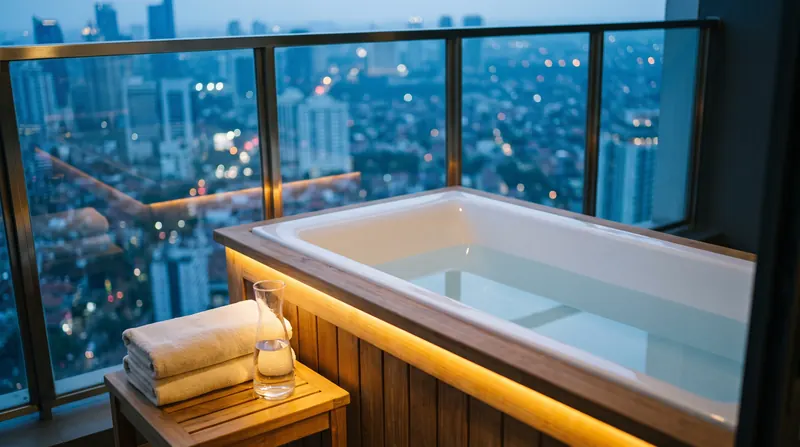
Penthouses are a class of their own — 11,000 VA and up, a private terrace, and expectations to match: a compact dry sauna inaudible from the bedroom, sometimes with a cold plunge on the terrace. Projects like these get our full standard: the cabin frame decoupled from the unit's structure so vibration never reaches the floor below, the chiller hidden behind a service wall, the heater ready to join smart home scenes via dry contact or Wi-Fi, and the management approval file walked through to signature. The whole legal-technical map is unpacked in our Jakarta apartment sauna guide.
World two: the heritage houses of Menteng
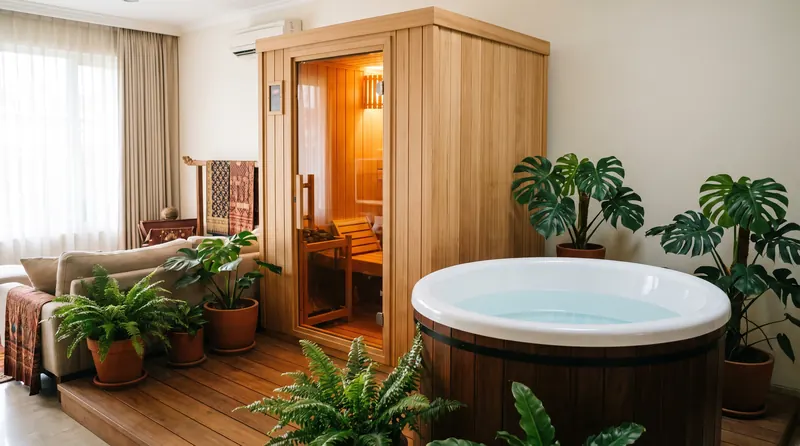
Menteng, Cikini, Gondangdia — colonial-era and 1970s houses with high ceilings, inner courtyards and the kind of space modern cluster homes never get. For a sauna, these houses offer the luxury of placement: an old pavilion becomes a wellness room, a back-garden corner takes an outdoor cabin, a second garage turns into a contrast room with sauna and plunge together.
Two things get extra care here. Old wiring: a panel and cables as old as the house must never carry a heater's load — we always pull a new run straight from the meter in SiHF cable with a dedicated breaker and ELCB, leaving the old installation to its own duties. Damp walls: old brick stores and releases moisture; our cabins never sit flush against an old exterior wall — there's always a ventilation gap and a full vapour barrier, so both the cabin and the historic wall get to breathe.
Menteng owners have usually had their fill of contractors who'll "check and get back to you" — so our quote is itemised from the start: this much for timber, this much for the heater, this much for the new electrical run. No "miscellaneous" line swelling mid-project.
What gets ordered most in Central Jakarta
The popularity order differs from other districts. First, infrared cabins — tracking the dominance of high-rise living. Second, compact 2-person dry saunas for houses and penthouses — a 1.5×1.2 m footprint that fits tight spaces. Third, bathroom ice baths — a compact tub with the chiller in the service area, favoured by apartment dwellers whose routine is cold exposure rather than heat. Full contrast packages are rarer than in South Jakarta — the space is simply harder to find — but the penthouses and Menteng houses that do order one get the most dramatic rooms: high ceilings and city windows.
Prices don't differ from other districts: infrared IDR 30–70 million, custom dry saunas 60–120 million, complete ice baths 45–90 million, all listed in the pricing page. The sauna types, and how to choose for your home, are in our guide to choosing a sauna type.
Logistics and surveys in the heart of the city
Working in Central Jakarta means making friends with odd-even traffic hours, basement loading docks and building managers who want paperwork before the first screwdriver goes in. Our team is used to it: apartment surveys are booked alongside vendor access permits, materials go up the service lift in the building's allotted slots, and noisy work is compressed into the hours the house rules allow.
For Menteng and nearby houses the survey is simpler — agree a time, the team comes to measure the space, check the electrical panel and photograph the material route. All free, across Central Jakarta, and the result is a quote you can weigh up with nobody chasing you. The neighbouring districts have their own pages: South Jakarta for premium landed homes, West Jakarta for family clusters, and North Jakarta for rooftops and ice baths.