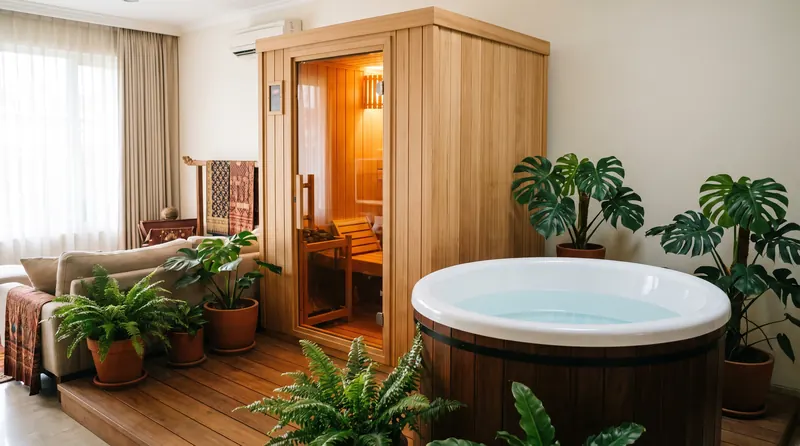
The three sauna types going into Jakarta homes — dry, steam and infrared — are separated by three numbers: working temperature, humidity and power draw. The dry sauna plays at 70–90°C with nearly steam-free air and a 6–9 kW heater. The steam room wraps you at 40–45°C with humidity near 100% from a steam generator. The infrared cabin heats the body directly at 45–60°C with 1.7–2.4 kW panels. All three deliver sweat and relaxation; the differences are in sensation, cost, and — often the decider in Jakarta — how many VA your house has to offer.
Comparison table: three types at a glance
| Dry sauna | Steam rooms | Infrared | |
|---|---|---|---|
| Temperature | 70–90°C | 40–45°C | 45–60°C |
| Humidity | 10–20% | ~100% | dry |
| Power | 6–9 kW | 6–9 kW (generator) | 1.7–2.4 kW |
| VA required | 7.700–11.000 | 7.700–11.000 | 2,200 is enough |
| Heat-up time | 30–45 min | 20–30 min | 10–15 min |
| Indicative price | IDR 60–120 million | IDR 50–100 million | IDR 30–70 million |
| Installation | 2–4 weeks | 3–5 weeks | 1–2 days |
The dry sauna: classic heat you can dose
This is the picture that appears when someone says "sauna": a timber cabin, a stone-filled heater, hot air that's dry and clean. Because humidity is low, the body tolerates high temperatures — sweat evaporates fast, breathing stays easy, and you dose the intensity by where you sit: the top bench for full heat, the lower bench gentler. Ladling water over the stones (löyly) sends a momentary wave of steam that lifts the sensation without changing the dry character.
It's the most "powerful" sensation of the three, and most sauna health research — from the heart to sleep quality — was done on this type (summarised in our sauna benefits article). Its Jakarta price: custom 2×2 m IDR 60–120 million, the budget variant from 40 million. Its main demand is electrical — a 6–9 kW heater means a 7,700–11,000 VA connection — plus properly layered construction to survive the city's humidity.
The steam room: full steam for those who don't like biting heat
The steam room works in reverse of the dry sauna: lower temperature, maximum humidity. Steam from the generator fills the mosaic-lined room until you can't see the far wall, every breath feels warm and wet, and sweat mixed with condensation coats the skin from the first minute. Plenty of people who find a dry sauna "too harsh" settle in happily here — and the steam bath tradition has long roots in Asia.
Its construction is the most demanding: total waterproofing, floors sloped to a drain, a pitched ceiling so drips don't land on heads, and a ceramic or mosaic finish. Hence the 3–5 week build — longest of the three — at IDR 50–100 million for 2×2 m. The steam generator draws as much as a dry heater, so the VA question still applies.
The infrared cabin: the lowest-friction way in
An infrared sauna's panels don't heat the air — they heat you. The waves penetrate a few millimetres into the tissue, the body sweats hard at a room temperature of "only" 45–60°C, and the session feels lighter even though the sweat is serious. To some people that's a compromise; for Jakarta conditions it's often the answer: 1.7–2.4 kW runs in a 2,200 VA home with no PLN upgrade, the unit stands free without touching the structure, and installation takes 1–2 days.
Thanks to those three traits — power-light, renovation-free, fast — infrared is the only type that almost always gets into an apartment (the full guide is here). Price IDR 30–70 million depending on size and panel class.
Match it to your home, not the trend
Our installation experience across Jakarta reduces this decision to three questions. How much power do you have? 2,200–3,500 VA with no plans to upgrade → infrared, done. 7,700 VA and up, or ready to upgrade → all three are open. Where will the unit stand? An apartment → infrared (or a compact steam/dry if the building allows). A landed house → anything goes, outdoor cabins included. What sensation are you after? Strong heat that "burns off" stress → dry. Soft, enveloping steam → steam. Efficient sweat with no drama → infrared.
And one bonus question we hear more and more: "can it be combined with cold water?" It can — in fact the sauna + ice bath package is our fastest-growing product, because hot-cold contrast delivers an effect heat alone can't.
Costs after the purchase: the monthly numbers
A dry sauna at 2–3 sessions a week adds IDR 200–500K a month to the electricity bill; a steam room 300–600K; infrared 100–250K. Annual upkeep is light for all three: a heater/generator/panel check, stone replacement if any crack (for the dry type), and cleaning you can do yourself. The lifespan of the imported components — Harvia, Sawo, Tylo — with parts available means a well-kept unit passes ten years without a sad story. As for the up-front numbers — cabin, electrical work, and the line items quotes tend to forget — we break them down component by component in our Jakarta sauna cost breakdown.
Still unsure? Start with the room
The fastest way to decide isn't more reading — it's measuring. Send photos of the room or corner you have in mind via WhatsApp to the custom sauna construction team: from the size, ventilation and installed power, usually only one or two types genuinely make sense for your space — and the conversation turns short, concrete and numerical. Surveys and quotes are free across DKI Jakarta.
Read next: A smart-home-connected sauna in Jakarta: phone preheat, schedules and sensors.