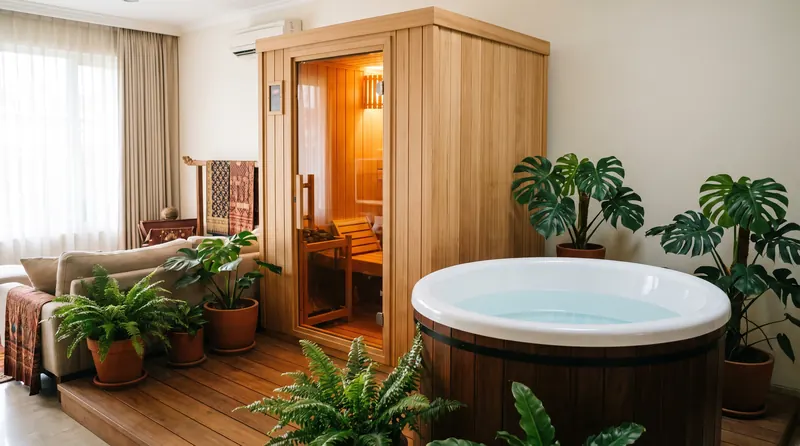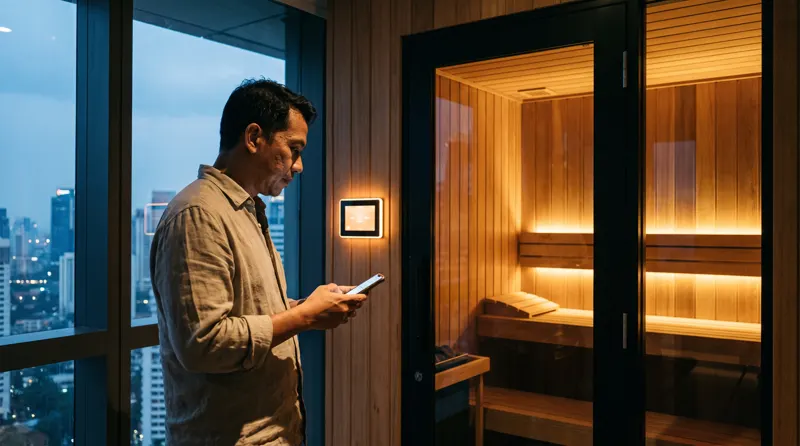
A sauna can join the smart home with three genuinely useful functions: preheat from your phone 30–45 minutes before you reach home, a weekly schedule that switches the heater on and off by itself, and sensors for temperature, the door and power consumption reporting into your home app. All of it comes via the heater manufacturers' official Wi-Fi control panels (Harvia Xenio/MyHarvia, Tylö, Sawo Innova) or a smart relay on the control circuit — never on the heater's power circuit. It adds around IDR 5–15 million to the quote, and one rule is non-negotiable: the thermal and time safeties keep working without the internet.
In Jakarta, where the drive home from SCBD to Kemang can swallow 90 minutes, starting the sauna from the car is no gimmick — it's why the compact penthouse and townhouse units we install through our Jakarta sauna construction service are almost always asked to join the home system.
What can genuinely be connected
- On/off and target temperature. From the manufacturer's app or via integration with Google Home, Apple Home and Home Assistant. You set 80°C from the toll road; the cabin is ready when you arrive.
- Schedules. The sauna comes on at 05:30 every Tuesday to Thursday and switches itself off at 07:00. For homes with a steady rhythm, this is the most-used function.
- Sensors. Temperature and humidity inside the cabin, a door contact (the heater must never preheat with the door open), and an energy meter showing how many kWh your sauna used this month.
- Scenes. "Recovery evening": sauna to 80°C, ice bath chiller to 8°C, hallway lights dimmed, music on the bathroom speaker — one tap.
- The ice bath chiller. Modern inverter units carry their own Wi-Fi control; if not, a smart relay on its contact is enough, since the load is small. Details on the Jakarta ice baths.
What you shouldn't hand over to automation
The high-temperature cut-off, the maximum-time limiter and the door sensor must stay in the manufacturer's control circuit, working without Wi-Fi, backup power or an app. We never put a generic smart relay directly on the 6–9 kW power circuit — the current is too much for a 16 A household relay, and its failure mode welds "on". What gets automated is the signal to the control panel, not the heater itself. It's also why we prefer the manufacturer's official Wi-Fi panel: the manufacturer owns the safety logic, and the heater's 1–2 year warranty stays intact.
Three integration routes and their costs
| Route | How it works | Best for | Added to the quote |
|---|---|---|---|
| Manufacturer's Wi-Fi panel | The heater's control panel with its official app (Harvia, Tylö, Sawo); Google/Apple Home integration through the app | Almost every home; simplest and under warranty | IDR 5–9 million |
| Smart relay on the control circuit | A dry contact from the smart home system sends a "start" signal to the panel; the safeties stay in the panel | Homes with Home Assistant, KNX or Control4 already installed | IDR 3–6 million + your integrator |
| Building/penthouse systems (KNX, Crestron) | A heater panel with a Modbus interface or dry contact tied into the building system by an integrator | Penthouses and villas with an official integrator | IDR 10–15 million on the sauna side, the rest with the integrator |
Indicative figures, on top of the sauna unit itself (a compact 2×1.5 m cabin at IDR 60–120 million). Every product range is in the pricing page.
Network and power: the two things people forget
A sauna cabin is a timber box with aluminium foil in its walls — a small Faraday cage. The Wi-Fi panel sits outside the cabin (usually beside the door), and the interior sensors connect over heat-rated cable, not wirelessly. If your router lives on another floor, plan an access point near the sauna. On the power side, automation changes nothing: a 6–9 kW heater still wants 7,700–11,000 VA, its own run from a dedicated MCB, SiHF cable inside the cabin, and an ELCB. If that supply isn't available — common in apartments — a 1.7–2.4 kW infrared cabin with a Wi-Fi panel is the route we recommend; the apartment scenario is covered in our article on saunas in Jakarta apartments.
Three set-ups we often install in Jakarta
A South Jakarta penthouse. A compact 2×1.5 m sauna with a Wi-Fi panel, tied into the existing building system by the owner's integrator. Automatic preheat when the owner's car is detected entering the basement via a phone geofence. The ice bath chiller on the service balcony joins the same scene.
A townhouse in Kemang. A simple weekly schedule through the manufacturer's app, no other home system. The sauna comes on at 05:45 three times a week for pre-work sessions; the energy meter shows around 45–60 kWh a month.
A family home in Central Jakarta. Home Assistant sends the start signal to the panel; the door contact blocks preheating if the door is open; the parents' phones get a notification if the sauna comes on outside the hours allowed for the teenagers.
The protocol that gains most: the 30-minute contrast
Automation is felt most in the hot–cold ritual. A sauna already at 80°C and water already at 8°C when you get home turns the 30-minute protocol from "maybe later" into a habit. We wrote the protocol up in our 30-minute contrast therapy article; the smart home just makes sure both ends are ready at the same time.
Access and safety: who gets to switch the sauna on
Once the sauna is in an app, the question shifts from "can it" to "who may". Manufacturer apps generally support multiple users with different rights: a full owner, family members who can switch it on but not change the maximum temperature, and guests with temporary access. For homes with teenagers we recommend an 80°C temperature cap and a 45-minute duration limit only the owner can change, plus a notification to the parents' phones every time the heater fires up.
For housekeepers or villa staff readying the sauna before guests arrive, a schedule beats app access: the heater comes on by itself at 16:30, and staff only make sure the bucket is filled and towels are out. And one rule we write into every handover document: the sauna is never started remotely if a small child could be home without adult supervision — the door sensor blocks preheating while the door is open, but it does not replace a parent.
Want to know whether your home system can talk to a sauna? Send the smart home brand (or your integrator's name) with photos of the room and the VA number on your meter via WhatsApp — we reply with the integration route that makes most sense and a quote that separates the sauna's cost from the automation's.