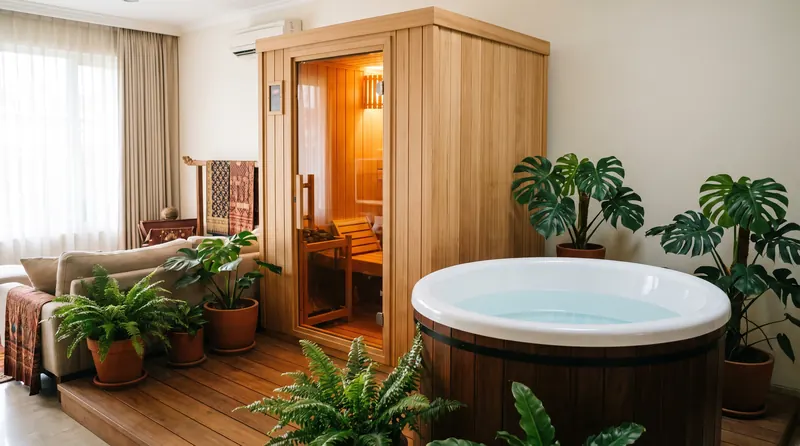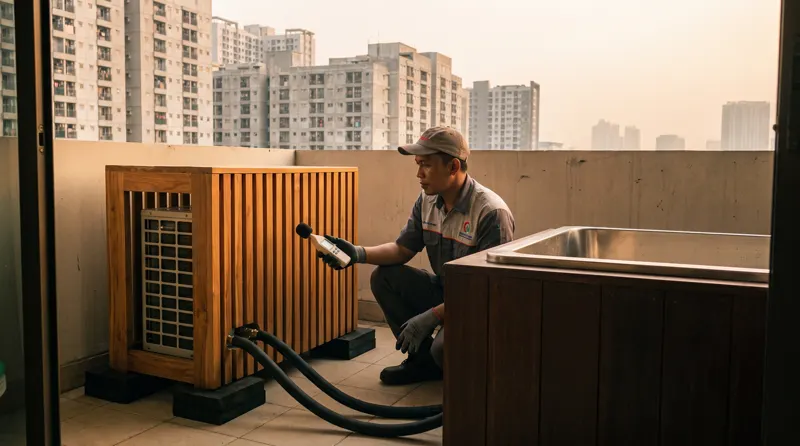
A ½–1 HP ice bath chiller produces 50–60 dB at one metre — roughly a split AC's outdoor unit. In a house's yard that disappears; on a 30 m² apartment balcony or in a townhouse sharing a wall with the neighbours, it's a complaint waiting to happen. Five steps bring it down to 40–45 dB, the level of quiet conversation: choose an inverter unit, anti-vibration pads, a ventilated damping box, distance and direction done right, and a cooling schedule set to insensitive hours. The combination of all five is the installation standard of our Jakarta ice baths for high-rise homes and townhouses.
This topic rarely makes the brochures, yet it decides whether your ice bath survives apartment life past the first month. Building management has no quarrel with a tub of water; what brings them knocking is the hum at 11 pm.
Where chiller noise comes from
Three sources. The compressor makes a low-frequency hum that travels through the structure — this is what gets through walls. The condenser fan makes a mid-frequency hiss that travels through the air. Water flow and the circulation pump add a burble that's usually the mildest. Each source has a different fix, and the common mistake is wrapping the chiller in foam: that muffles the fan, but overheats the compressor and does nothing at all about structural vibration.
Step 1: an inverter unit, not on/off
A conventional on/off chiller runs flat out then falls silent — the hum comes and goes, more annoying than a steady sound. An inverter unit modulates the compressor: once the water hits 8°C, it idles along at 30–40% capacity around 45–50 dB, barely changing all night. The premium is IDR 5–10 million over a standard unit within the IDR 25–55 million chiller range, and it's the most effective investment on this whole list.
Step 2: break the vibration path into the structure
The compressor sends vibration into the balcony floor, the floor passes it to the walls, the walls to the neighbour's bedroom. 20–30 mm anti-vibration rubber pads under all four feet — or spring mounts for a 1 HP unit — cut that path. The chiller must touch no wall, railing or pipe; the hose to the tub gets a 50 cm flexible section so it can't become a vibration bridge. This is the cheapest step — under IDR 1 million — and the one general installers skip most.
Step 3: a damping box that still breathes
A proper damping box is a cabinet lined with acoustic panels on the inside, an air inlet grille at the bottom and an outlet on the opposite side aimed away from the neighbours, with an internal volume at least twice the chiller's. It takes 8–12 dB off the fan noise without raising the working temperature more than 3–4°C. A sealed, unventilated box is actively harmful: the condenser sucks back its own hot air, power consumption climbs, and the compressor's life shortens. On open apartment balconies, a slatted teak or ulin box often doubles as the aesthetic fix.
Step 4: distance and direction
Every doubling of distance drops the level by about 6 dB. A chiller at the far end of the balcony, 3 m from the neighbour's window, is far better received than one 1 m from the dividing wall. Aim the fan's discharge at open space or your own building's wall, never at the next unit. In a townhouse, put the chiller on the garden or carport side, not in a narrow service alley that bounces the sound into both houses.
Step 5: cool at the right hours
Water already cold stays cold in an insulated tub with a lid: overnight in Jakarta it gains only 1–2°C. Schedule the full cool-down for 10:00–17:00 while the building is busy and the neighbours are at work, and let the chiller sit silent or idle from 22:00–06:00. With an inverter unit and Wi-Fi control, that schedule is two taps in the app — and your 05:30 session still gets 8°C water.
The numbers you can expect
| Configuration | Sound level at 1 m | Audible from the neighbour's room? |
|---|---|---|
| On/off chiller on the balcony floor, no pads | 55–60 dB | Yes, a clear hum |
| Inverter + anti-vibration pads | 47–52 dB | Faint, only on silent nights |
| Inverter + pads + ventilated box + correct direction | 40–45 dB | No, on par with quiet conversation |
We measure it with a sound meter at handover and record the figure in the project documents — useful if building management ever asks.
Apartments: approval, load and water
Before the noise, three other things have to be squared away in an apartment: management approval for a 400–600 litre tub on the balcony (a 500–700 kg load on a small area, often needing structural sign-off), fill and drain routes for the water, and power — a ½ HP chiller draws just 400–600 W, nowhere near a problem. The full review of building rules is in our article on saunas in Jakarta apartments; the principles are the same for an ice bath. For beginners just starting with cold water, the temperature and duration protocol is in our ice bath beginners guide.
The checklist before choosing a chiller for dense housing
- The sound level on the spec sheet — ask the seller for the dB figure at 1 m; a unit that doesn't list one is usually not a quiet unit.
- Inverter, not on/off, for night use and shared-wall locations.
- The right capacity: ½ HP for a 350–550 litre tub, 1 HP for 800–1,000 litres. An undersized unit runs nonstop, and that gets heard.
- Rubber feet or spring mounts included, or budgeted separately.
- The fan's discharge direction adjustable — some units blow sideways, some upward; pick the one that suits your balcony's position.
- Wi-Fi control or a timer to schedule daytime cooling.
- Servicing in Jakarta: compressors and fans are wear parts; make sure the spares and the technicians exist in this city, not just in the brochure.
Tick these seven points and follow the five placement steps above, and an ice bath chiller is a quieter neighbour than most of the AC units in your building.
Our ice bath packages with a chiller in the IDR 45–90 million range already include anti-vibration pads and correct placement; the ventilated damping box is offered as a separate line in the quote. The full ranges are in the pricing page. Send photos of the balcony or the side of the house where the chiller will stand, plus the rough distance to the neighbour's window, via WhatsApp — we reply with our recommended configuration and its expected sound level.
The tub and chiller themselves — sizes, prices, installation — are laid out on the Jakarta ice baths. Notes on the buildings along the Sudirman corridor are on the Sudirman apartment saunas.